Posts

Benefits of using an Enterprise Resource Planning (ERP)

Enterprise Resource Planning (ERP): Software has become a critical component of modern businesses, providing organizations with a centralized platform for managing their operations and automating their core processes. There are many benefits to using ERP software, including improved efficiency, reduced costs, and enhanced visibility into operations. Improved Efficiency: ERP software can help organizations streamline their operations, reducing manual processes and automating core functions. This can help organizations improve their efficiency, reduce their costs, and ensure that they are delivering quality products and services in a timely manner. Reduced Costs: ERP software can help organizations reduce their costs by automating manual processes, reducing errors, and improving the accuracy of data. Additionally, ERP software can help organizations optimize their operations, reducing waste and improving efficiency. Enhanced Visibility: ERP software can provide organizations with a co...

Disadvantages not using an Enterprise Resource Planning (ERP)

Enterprise Resource Planning (ERP):   Systems have become an essential tool for modern businesses, helping organizations manage their operations and automate their core processes. However, not using an ERP system can lead to a number of disadvantages, including reduced efficiency, increased costs, and limited visibility into operations. Disadvantages: Disjointed Operations: Without an ERP system, organizations can have disjointed operations, with different departments using different systems and processes. This can lead to inefficiencies and data silos, making it difficult for organizations to get a comprehensive view of their operations. Limited Visibility: Without an ERP system, organizations can have limited visibility into their operations, making it difficult to identify areas for improvement and make informed decisions. This can lead to increased costs, reduced efficiency, and poor customer service. Increased Costs: Without an ERP system, organizations can be forced to rel...

Advantages of using an Enterprise Resource Planning (ERP)

Enterprise Resource Planning (ERP):   Systems have become a critical component of modern businesses, providing organizations with a centralized platform for managing their operations and automating their core processes. There are many advantages to using an ERP system, which can help organizations improve their efficiency, increase their bottom line, and stay ahead of the competition. Advantages: Improved Data Integration: One of the biggest advantages of ERP systems is their ability to integrate data from various functions and departments into a single platform. This helps organizations get a real-time view of their operations and make better use of their data, which can lead to improved decision-making and increased efficiency. Streamlined Processes: ERP systems can automate many of an organization's core processes, reducing the need for manual intervention and freeing up time for more strategic tasks. For example, an ERP system can automate the procurement process, eliminating...

What is an Enterprise Resource Planning (ERP)

Image
Enterprise Resource Planning (ERP) Enterprise Resource Planning (ERP) is a type of software that helps organizations manage and automate their core business processes. It integrates various functions, including finance, human resources, procurement, and supply chain management, into a single system. This helps organizations streamline their operations and make better use of their data, which can lead to improved decision-making and increased efficiency. The concept of ERP originated in the manufacturing industry in the 1990s, when companies were seeking ways to integrate their disparate systems into a single, centralized platform. Over time, the scope of ERP has expanded to encompass a wide range of industries and functions, and today, ERP systems are used by organizations of all sizes, from small businesses to large multinational corporations. One of the key benefits of ERP is its ability to provide a comprehensive view of an organization's data. By integrating data from various f...

Machine Learning Technology

Image
Machine Learning Technology Machine learning is a subfield of artificial intelligence that focuses on developing algorithms and models that allow computers to learn and make predictions based on data. The concept of machine learning has been around for many decades, but recent advancements in computing power and data storage capabilities have made it possible to train more complex models and apply them to a wider range of problems. One of the key benefits of machine learning is its ability to automatically improve over time. With traditional software, developers must manually write code to perform a specific task. With machine learning, algorithms learn from the data they are provided and make predictions based on that data. As the algorithm is exposed to more data, it can continue to improve its predictions. This means that, with time, the algorithm becomes more accurate and requires less human intervention. There are many different types of machine learning algorithms, each with its ...

Internet of Things (IoT) Evolution

Image
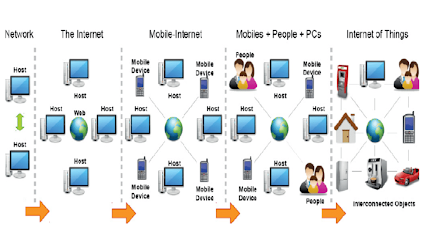
Internet of Things (IoT) Evolution The Internet of Things, or IoT, is a network of physical things like cars, buildings, electronics, software, sensors, and connectivity that lets these things collect and share data. It is a rapidly growing technology that is transforming the way we live and work, by allowing us to connect and control a wide range of devices from anywhere, at any time. The evolution of IoT can be traced back to the 1980s when the first ideas of connecting everyday devices to the internet were proposed. However, it wasn't until the early 2000s that the concept of IoT began to gain momentum, as the cost of connectivity and computing power decreased, and the availability of wireless networking increased. In the early days of IoT, the focus was on connecting simple devices such as sensors and appliances to the internet, to allow for remote monitoring and control. These early IoT devices were typically standalone and didn't communicate with each other, making it dif...

Natural Language Processing (NLP)

Image
Natural Language Processing (NLP) Natural language interaction between computers and humans is the focus of the Artificial Intelligence (AI) subfield known as Natural Language Processing (NLP). The development of models and algorithms that enable computers to comprehend, interpret, and generate human language is the objective of NLP. NLP has a wide range of applications, from language translation and sentiment analysis to speech recognition and text-to-speech synthesis. It also plays a crucial role in improving the accuracy and efficiency of other AI systems, such as chatbots, voice assistants, and recommendation systems. The complexity of human language is one of the main obstacles in NLP. Natural language is rich and diverse, and often contains ambiguity, sarcasm, and figurative language that can be difficult for computers to understand. To overcome these challenges, NLP researchers use a combination of statistical methods and machine learning algorithms to develop models that can au...